
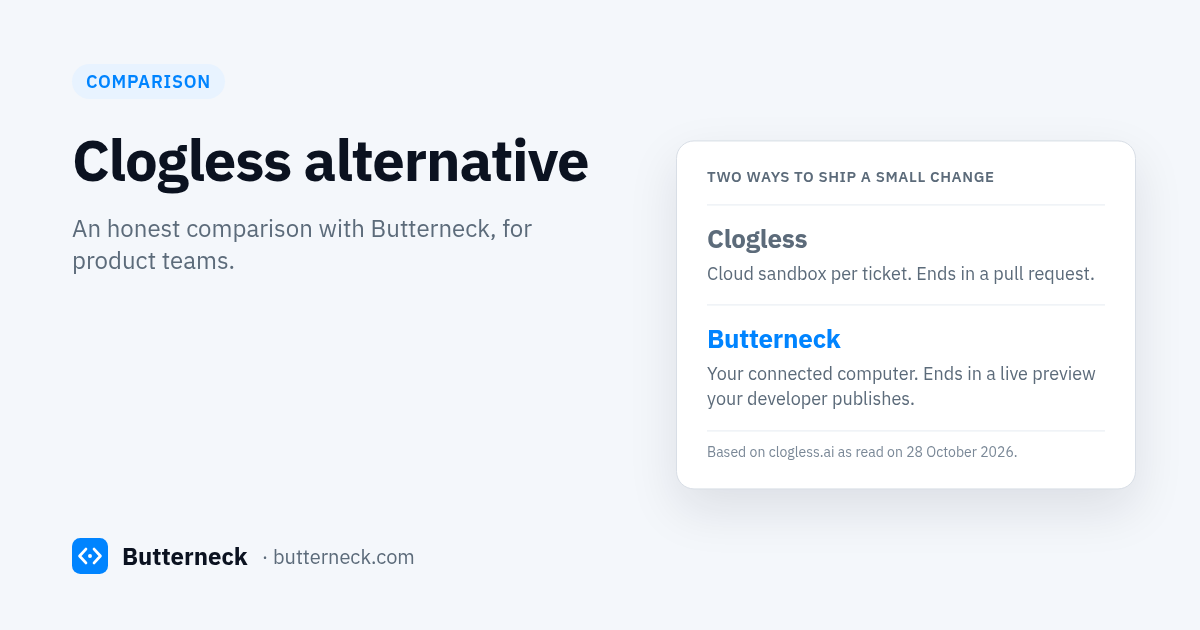
If you are weighing Clogless and wondering whether an alternative fits your team better, this post compares Clogless and Butterneck side by side. We make Butterneck, so we are not neutral. The two products go after the same problem: small product changes that sit in the engineering backlog. They solve it in different ways. We have tried to stick to what each product says publicly, and to be clear about where Clogless is likely the better pick.
Everything about Clogless below comes from its public website, clogless.ai, as read on 28 October 2026, mainly its home, how it works, ticket to pull request, security, and pricing pages. Clogless is a new product, and new products change fast. Check their site for the current details.
What Clogless says it does
Clogless calls itself an "AI workspace that turns tickets into pull requests". Its home page says its agents "take any idea from plan to live preview on your codebase in a secure cloud environment, then hand engineering a pull request instead of a request."
Its site describes three ways to start work:
- Explore, from an idea: draft a PRD with its agents and see the change on your real product, ending with a ticket and an open PR.
- Solve, from an existing ticket: agents work the ticket in an isolated environment while you watch and steer.
- Ship, from an existing PR: comment on the PR and Clogless deploys a live environment for reviewers to click through.
Each unit of work gets "a disposable, isolated cloud sandbox". You configure its shape once (base image, services, secrets, integrations), and each environment cleans itself up when the work merges or goes idle.
For tickets, Clogless says: "Connect your ticketing system once, then open the ticket you want to work on in Clogless." When the change is ready, "Clogless opens a pull request with your Git provider", and engineering reviews and merges it.
Its ticket-to-PR page lists Jira, Linear, Trello, monday.com, Notion, and Asana for tickets; GitHub and Bitbucket for Git; and React, Next.js, Angular, and Vite as frameworks. Figma and Slack integrations are included on every plan. Admin roles ship on every plan, and Team and Enterprise add role-based permissions.
What Butterneck does
Butterneck handles the small change on a product that already runs, and stops before anything goes live.
- A developer installs a small connector on a computer that already has the project and a coding assistant already signed in: Cursor, Claude Code, or Antigravity (team, enterprise or API plans recommended).
- A PM or stakeholder opens a share link to a live copy of the app and types the change into a chat next to the screen they mean. Or someone adds the label
butterneckto a Jira ticket and assigns it. - The coding assistant on that computer edits the connected project, and the preview updates on the same link.
- The developer reads the conversation, checks the change, and publishes it the way the team already does.
Butterneck never opens pull requests, never merges, and never deploys. You decide what goes live.
The main differences
Where the work runs
Clogless runs each idea, ticket, or PR in its own cloud sandbox, set up once from a base image, services, and secrets you configure.
Butterneck runs on a computer your team connects, in a project that already runs there, with the coding assistant that is already signed in (team, enterprise or API plans recommended). There is no per-ticket environment to configure. The trade-offs are real: that computer has to be on for the preview to load and for work to start, and .env handling is a guardrail, not a hard block. Secret settings files are on an ignore list the AI is told to stay out of, so keep production secrets off that computer. More on data flow in how the agent runs on your machine.
What you get at the end
Clogless ends in a pull request that it opens with your Git provider.
Butterneck ends in edited files in the connected project and a running preview. There is no bot PR. The developer who checked the preview commits the change, opens a PR, or throws it away, so the change has a human owner from the start. We wrote about why that matters in AI pull requests need an owner. Some teams want the PR made for them; others want the AI kept out of the release pipeline. That is the clearest fork between the two tools.
How a Jira ticket starts the work
In Clogless, you connect your ticketing system and open the ticket in Clogless.
In Butterneck, the work starts inside Jira. Add the label butterneck to a ticket and assign it to someone whose computer has the project. A private copy opens, named after the ticket, and the title, description, comments, and attachments become the request. When the AI is done, a short note and a preview link are posted back to the ticket. We did not find a description of posting results back to the ticket on Clogless's public pages. Ask them if that matters to you. Details on the Jira integration page.
Breadth
Clogless covers more ground: six ticketing tools (Butterneck supports only Jira Cloud), PRD drafting with agents, preview environments from a PR comment, and, on its Team plan, real-time collaboration and a context lake (its QA agents are not included on Team). Butterneck does none of those. It is built for one loop: someone asks for a small change, sees it on a live copy, and a developer decides.
Pricing
Clogless lists Starter at $99 per month and Team at $489 per month, billed annually, plus Enterprise through sales. Starter includes 1 project or repo and 2 environments; Team includes 4 and 8. AI usage is listed as "Credit / BYOK". We did not see a per-seat price on the page.
Butterneck has a free Starter plan for one developer and one person who asks for changes. Pro is USD 19 per person per month, billed monthly, with 20% off annual billing. You also pay for your own coding assistant subscription. Details on pricing.
Side by side
| Clogless | Butterneck | |
|---|---|---|
| Where the AI works | A cloud sandbox per idea, ticket, or PR | A connected computer that already runs the project |
| AI engine | Clogless agents; usage by credit or your own key | Your signed-in Cursor, Claude Code, or Antigravity |
| End result | A pull request with GitHub or Bitbucket | Edited files and a live preview; no PR |
| Who publishes | Engineering reviews and merges the PR | The developer publishes the usual way |
| Ticketing | Jira, Linear, Trello, monday.com, Notion, Asana | Jira Cloud only |
| How a ticket starts | Open the ticket in Clogless | Label butterneck and assign it in Jira |
| Back on the ticket | Not found on their public pages | A note and a preview link |
| Pricing | $99/mo Starter, $489/mo Team, billed annually | Free Starter; Pro $19 per person per month |
When Clogless fits better
Be honest about how your team ships.
- You want a pull request opened for you at the end of every change.
- Your tickets live in Linear, Trello, monday.com, Notion, or Asana rather than Jira.
- You want a fresh cloud environment for each change, with no team computer that has to stay on.
- You want agents to help draft the PRD before any code is written.
- You want live preview environments from a comment on an existing PR.
When Butterneck fits better
- Your requests already live in Jira and you want a label and an assignee to start the work, with the preview link landing back on the ticket.
- You want the AI to edit files and stop there. No PRs, no merges, no deploys.
- You would rather not configure a cloud environment, and the project already runs on a developer's computer.
- You already pay for Cursor, Claude Code, or Antigravity on a team or API plan and want the product team to use it through a connected developer computer.
- You want to start free and pay per person, month to month.
When neither is a fit
If you want changes to merge themselves, neither tool is built for that. Both keep engineering in charge of what ships. And if your request is a new feature that needs design and architecture work, start with your team, not a chat box.
FAQ
Is Butterneck a direct Clogless alternative?
For small changes on a live product, yes. Both let product managers and designers ask for a change and see it running before engineering accepts it. Clogless runs in cloud sandboxes and ends in a pull request. Butterneck runs on a computer your team connects and ends in a preview that a developer publishes.
Does Butterneck open pull requests like Clogless?
No. Butterneck edits files in the connected project. The developer decides whether to commit, open a PR, or discard the change.
Does Butterneck work with Linear, Trello, or Asana?
No. Butterneck's ticket integration is Jira Cloud only. Without Jira, people ask for changes in the chat on the live copy.
Does my code stay on my machine with Butterneck?
The files are edited on the connected computer, and Butterneck does not run its own model. But the coding assistant sends code context to its AI provider, and chat and preview traffic pass through Butterneck's server.
Can I try Butterneck for free?
Yes. Starter is free for one developer and one person who asks for changes.
Try it
If your team's small changes stall in the backlog, book a 30-minute demo and we will run a real request on a live copy. Or see pricing and start on the free plan. If you are comparing other tools too, we also wrote an Itera alternative comparison.